Raise the Bar
Tailored lighting solutions, delivering unrivalled performance for your strawberry plants.
What is it?
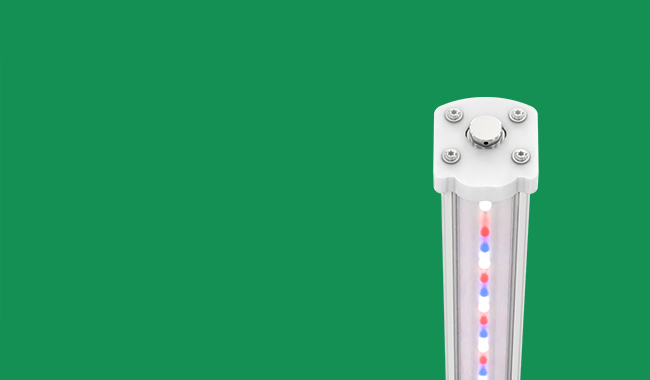
A customisable lighting platform adaptable in length, spectra, and performance to the unique requirements of your indoor farm.
- One adaptable platform
- Multiple configurations
- Unrivalled performance
- Optimised cost-of-ownership
- Up to 300 µmol/s (per bar)
- 5 year warranty
- Durable housing
- IP65
- Easy to clean
- Dynamic dimming
How does it work?
Engineered with collaborative customisation at its core, the Align Platform offers unrivalled performance by enabling growers to tailor every aspect of their lighting solution.

Customised Plant Spectra
Customised spectra to your specific strawberry variety

Personalised Strategy
Tailored PPFD to your cultivation strategy

Custom Fixtures
Fixture dimension & system configuration customised to your multi-layer, gutter & cart

Optimised Design
Bespoke optical design to optimise intensity & colour uniformity within the specified headspace
Flexible Electricals
AC & DE electrical configurations to align with your preferred power supply infrastructure

Mounting Solutions
Customised mounting solutions, cable trees, lead & plugs to facilitate installation & maintenance ease
What does this mean for my strawberries?
A significant PPFD, intensity and spectral uniformity improvement, resulting in shortened crop cycles, accelerated plant growth, and improved nutritional qualities.
Uniformity Leadership
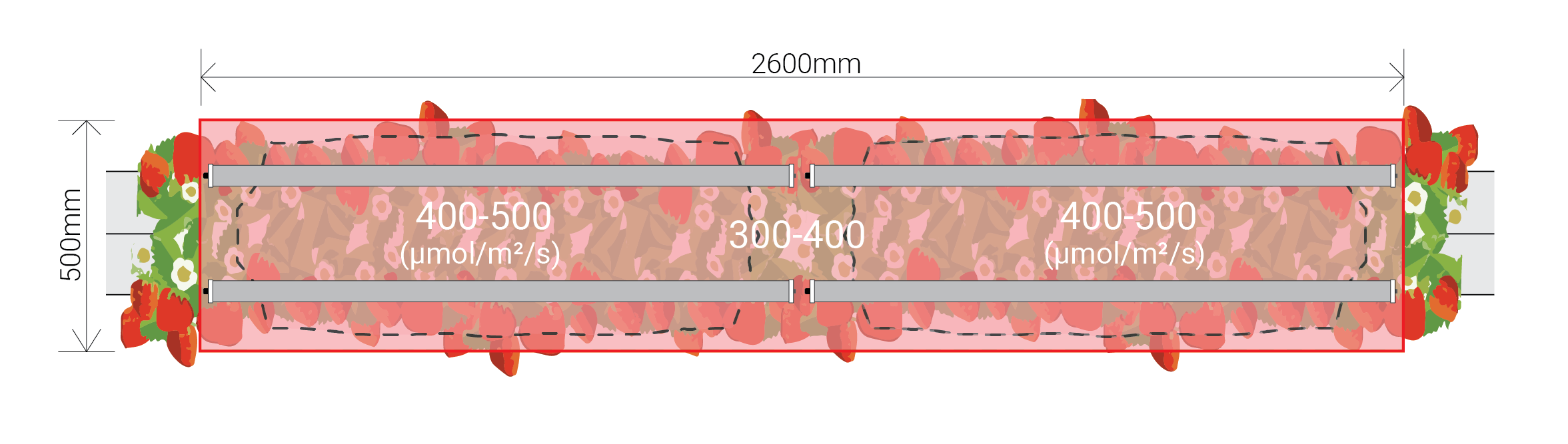
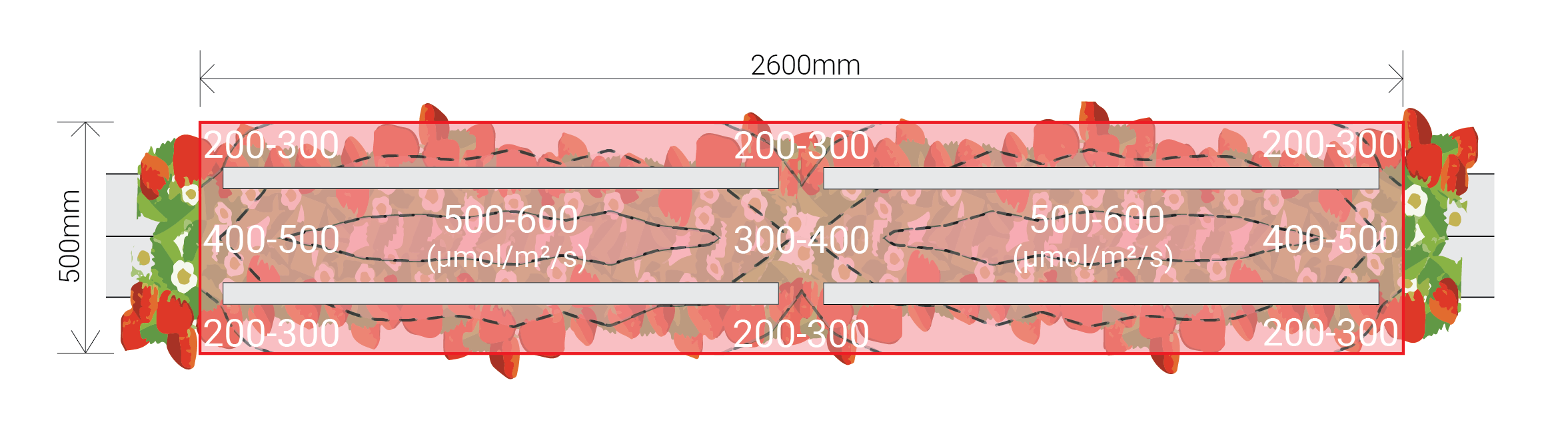
The Align Platform utilises custom extrusion manufacturing techniques, advanced LED, and optical technologies to ensure optimal photosynthetically active radiation (PAR) light-use efficiency and unmatched intensity uniformity, whilst requiring fewer light-bars vs the competition.
47% of Grow Area is +/- 10% of the 425µmol/m2/s PPFD Setpoint
71% of Grow Area is +/- 20% of the 425µmol/m2/s PPFD Setpoint
- 200 mm mounting clearance

Charlie Benson
Co-Founder and CTO
“Intensity uniformity is the consistency of total PAR light distributed over the growing area. This is typically measured at the crop canopy by the volume (%) of the grow area that falls within the specified tolerance of the PPFD setpoint.”
Spectrum Consistency
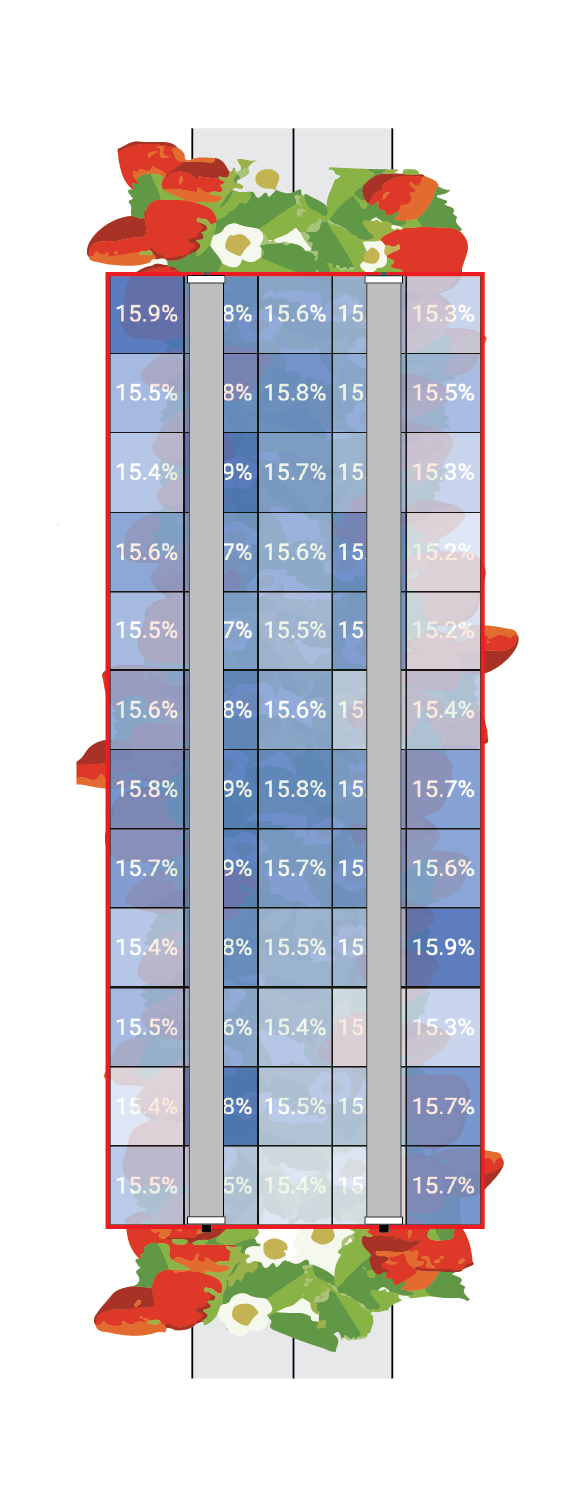
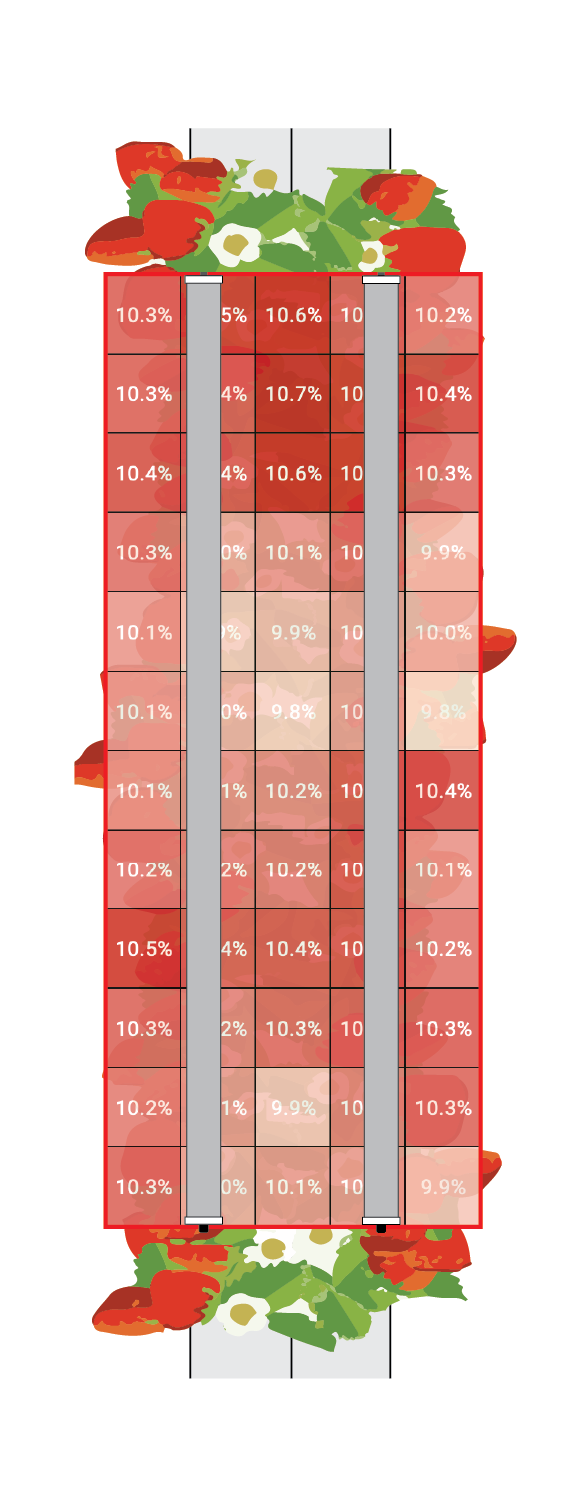
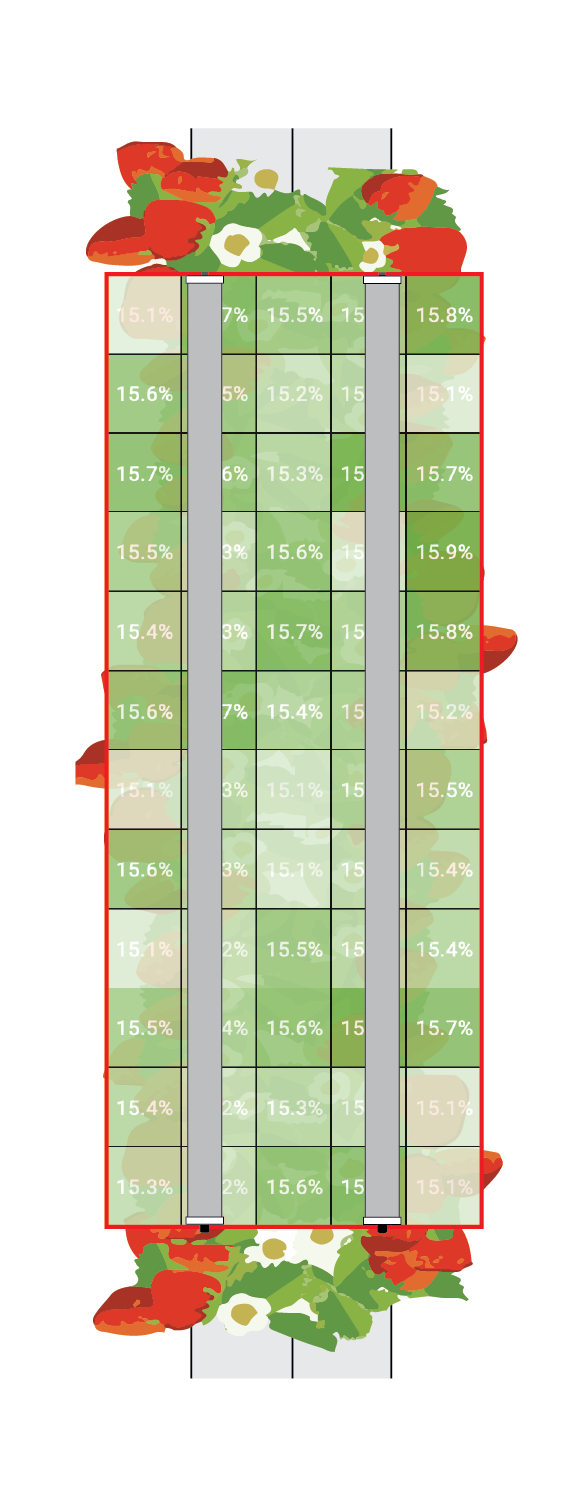
The Align Platform is engineered to be spectrally uniform and excel within low headspace (150mm), multi-layer environments. The PCB, LED & optical design ensures consistent distribution of the desired light recipe at the plant canopy with minimal deviation of the recipe’s wavelengths.
- 15% spectrum setpoint
- 15.2% minimum
- 15.9% maximum
- +/- 0.9% deviation
- 15% spectrum setpoint
- 15.1% minimum
- 15.9% maximum
- +/- 0.9% deviation
- 70% spectrum setpoint
- 68.5% minimum
- 69.5% maximum
- +/- 1.5% deviation

Charlie Benson
Co-Founder and CTO
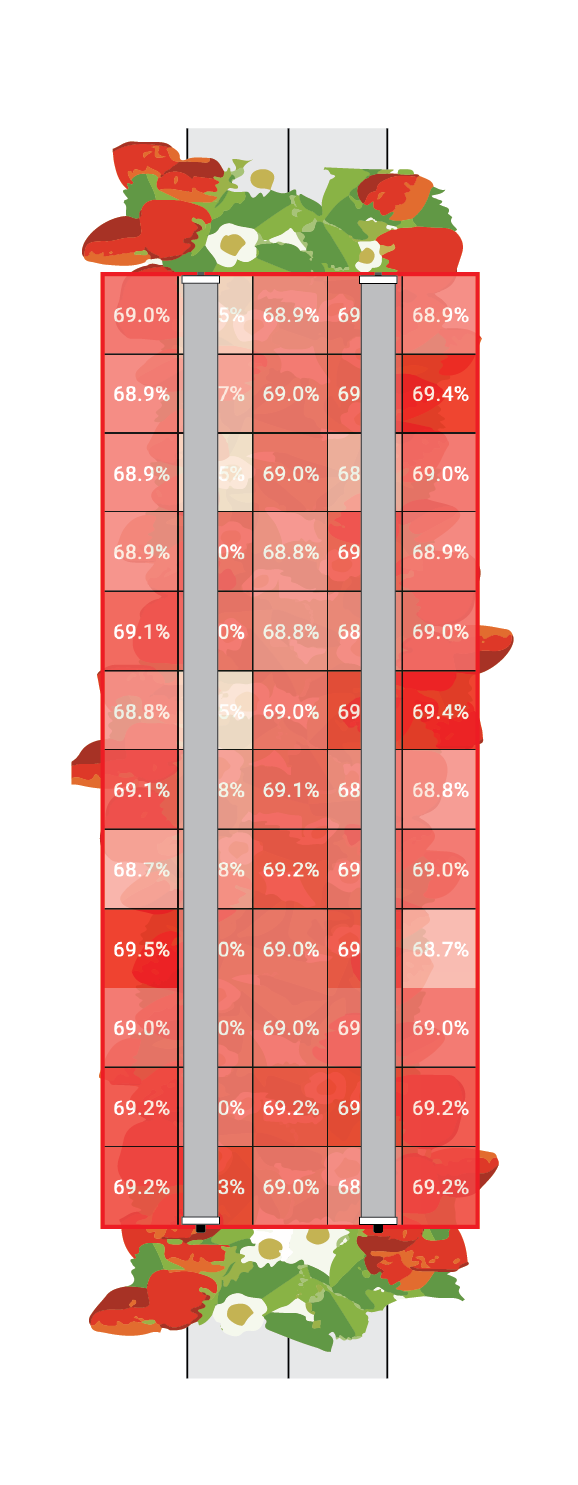
“Spectral uniformity is the deviation in PAR wavelength bands over the growing area, measured at the crop canopy, compared to the light-recipe emitted from the fixture and the spectrum setpoints.”
Using Bloem’s Wand Platform
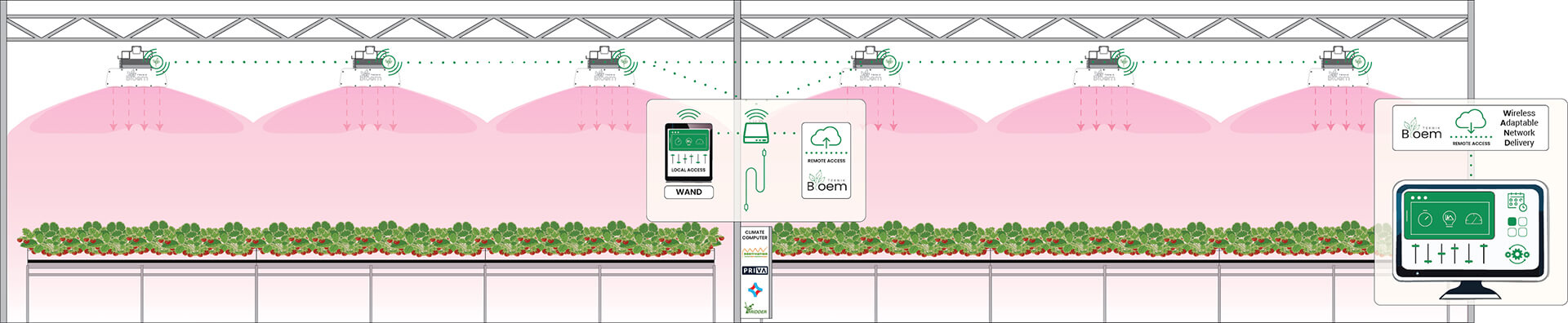
The Bloemteknik Wireless Adaptive Network Delivery (Wand) platform provides advanced dynamic control for single and multi-channel grow lights.

Secure, Reliable & Scalable
Our highly secure mesh solution, with no single point of failure, supports over 30,000+ devices per network

Flexible Lighting
Easily create zones, groups, light recipes, dimming schedules, DLI targets, and lighting scenes using our wireless control system with our LED grow lights

Closed-Loop System
Wand acclimates LED grow light output to prevent negative effects from weather or environmental changes

Plant-Centric Adaptability
Fixture dimension & system configuration customised to your Multi-layer, Gutter or Cart layouts

Seamless Integration
Wand can be used as a standalone lighting control system or integrated with climate control systems via the Horticulture Lighting Protocol (HLP)

Preventive Maintenance
Wand continuously monitors power supply temperature, power draw, operating hours, and system responsiveness to detect potential issues before they impact performance. This proactive approach minimises unexpected downtime and maximises the lifespan of the entire lighting system.
400 - 500 nm
Supplemental blue wavelengths can be used to enhance fruit yield while maintaining fruit quality
A plant signal for stomatal aperture which impacts transpiration, internal CO2 concentration and stomatic conductance
Increases compactness, biomass, leaf thickness and protein synthesis in strawberry plants
500 - 600 nm
Enhances photosynthesis in strawberry plants which is associated with an increased biomass accumulation
Promotes rooting which is associated with a higher accumulation of leaves and strawberry fruit
In combination with blue light may increase the total sugar concentration and acidity, enhancing the fruits sweet flavour
600 - 700 nm
Increased photosynthetic pigments and soluble carbohydrates in strawberry plants
Increased productions of phenolics including anthocyanins have been demonstrated to be enhanced by red light
Improves strawberry plant productivity and promotes specialised metabolite accumulation
700 - 800 nm
High R/FR ratios can increase plant height and width promoting better air movement and improved microclimates
Far-Red treatment in combination with blue light can help regulate flowering in strawberry plants
Far-Red wavelengths strongly influence day extension and may be used for night break management
Strawberry Plant Acclimation
(Long-day & Day-Neutral Cultivars)
Strawberry Plant Vegetative
(Long-day & Day-Neutral Cultivars)
Strawberry Plant Flowering
(Long-day & Day-Neutral Cultivars)
Strawberry Plant Fruiting
(Long-day & Day-Neutral Cultivars)
10-15
15-20
20-25
20-25
150-300
250-400
300-600
300-600
12-18
14-18
14-18
14-18
The quantity of photosynthetic active radiation (400 – 700nm) required is defined by the Daily Light Integral (DLI). DLI refers to the quantity of PAR the plant is exposed to within a single day (24-hour period). Each plant, including strawberry plants, have a minimum and maximum DLI to facilitate growth and this varies by development stage and plant variety. Typically, flowering, and fruiting stages of strawberry plants have a recommended DLI range of 20-25 mol/m2/day. The desired photosynthetic active radiation density (PPFD) can be calculated from the DLI target and exposure duration (photoperiod). For example, using a photoperiod of 16 hours provides the following formulae:
20 mol/m²/day / 16 hours / 60 minutes / 60 seconds = 347 µmol/m²/s minimum PPFD
25 mol/m²/day / 16 hours / 60 minutes / 60 seconds = 434 µmol/m²/s maximum PPFD
Increasing the photoperiod decreases the PPFD requirement to achieve a similar DLI (mol/m2/day) and the reverse can be said for decreasing the photoperiod and increasing the PPFD. The photoperiodic flowering responses of strawberry plants can be classified into either short-day, long-day and day-neutral types. Photoperiod is one of the primary factors that can elicit significant hormonal changes stimulating flowering and fruiting stages in strawberry cultivars. There is research suggesting increasing the DLI either by increasing the photoperiod or by increasing the PPFD can improve strawberry plant growth. However, extending the photoperiod can have a greater impact than a higher PPFD level on promoting flowering and early fruit production in long-day or day-neutral cultivars.
“Typically, strawberry flowering & fruiting stages have a recommended DLI range of 20-25 mol/m²/day.”
Get the Full Story
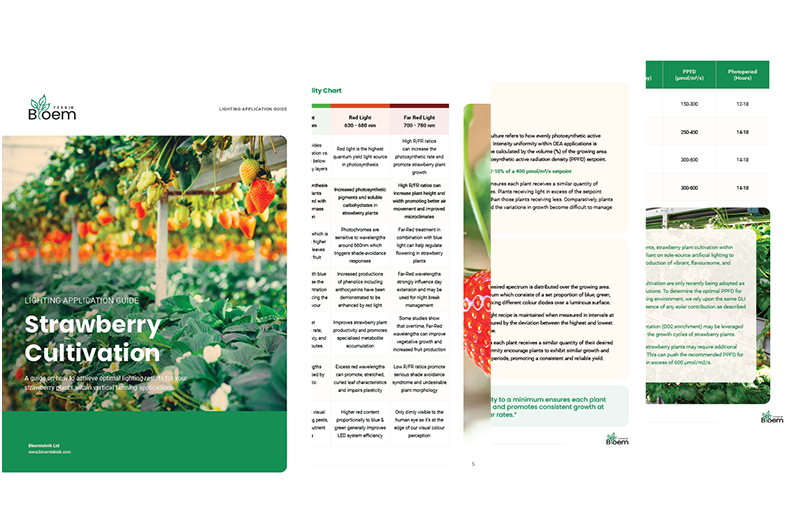
To see the complete list of light wavelength effects on strawberries, PPFD & photoperiods and much more please download our vertical farming strawberry cultivation lighting application guide.
Align Platform
A robust system that targets optimising productivity within multi-layer, gutter and cart applications, primarily built for low headspace and harsh working environments.
- Up to 3.5 μmol/J
- IP66
- 5 year warranty (L90 at 50,000h)
- Easy to clean
- Durable housing