If there’s one thing we’ve learned from working with cannabis growers, it’s that many of the same questions come up again and again. From light intensity and uniformity to spectrum selection and energy efficiency, growers are constantly looking for practical answers that improve cultivation outcomes. In this series, we tackle some of the most common questions we receive and share our perspective based on real-world experience and academic insights.
Should spectrum change during the crop cycle?
There is growing evidence that stage specific lighting strategies can improve harvestable yield and flower quality in cannabis, but this should not yet be treated as a universal rule. Adjusting light intensity to crop stage is well established, whereas the evidence for changing spectrum across the crop cycle is still emerging and remains strongly dependent on cultivar, production system, and the baseline environment. Studies indicate that changing the balance of blue, red, ultraviolet, and far-red photons can alter morphology, flowering behaviour, and, in some cases, secondary metabolite outcomes, but these responses are not yet sufficiently consistent to justify a blanket recommendation.
 The mechanistic links between specific wavebands and cannabinoid, terpene, and flavonoid biosynthesis are still not fully resolved. In particular, terpene responses appear more tuneable than cannabinoid concentrations, while flavonoid responses in cannabis remain less well characterised than in other crops. Some studies show that spectral changes can alter terpene accumulation without affecting total cannabinoid concentration, reinforcing the point that spectrum should be viewed primarily as a steering tool, not a guaranteed potency lever.
Our recommended best practice is still to use a high-quality broad-spectrum baseline, then apply spectral changes only with a clear agronomic objective, such as morphology control, crop steering, flowering management, or ripening strategy. Particular care should be taken with high red photon delivery under high light conditions, as this may increase photobleaching risk in sensitive cultivars; however, bleaching is typically a multi factor response involving total light intensity, cumulative DLI, tissue temperature, genetics, and broader crop environment interactions rather than red light alone. This is why any dynamic spectrum strategy should be validated first on your genetics, in your facility, at small scale before being rolled into production.
How many hours per day should supplemental lighting run?
 Supplemental lighting duration should be determined by photoperiod requirements and Daily Light Integral (DLI) targets, not by runtime alone. In flowering, cannabis is most commonly managed under a 12-hour photoperiod, but controlled work shows that some cultivars can maintain commercially useful flowering responses under 13 hours, increasing DLI and substantially increasing inflorescence yield without reducing major cannabinoid concentrations. That is not universal across all genetics, but it shows that 12 hours should be treated as a robust standard rather than an absolute biological rule.
In greenhouse cultivation, supplemental lighting should ideally be adaptive and used only when natural light is insufficient to meet the target DLI for the crop stage, depending on geography. That approach improves energy use and better aligns electrical input with what the crop is actually receiving from sunlight. Recent greenhouse work confirms that higher supplemental light levels can strongly increase growth, flower yield, and water use efficiency, but the response is driven by cumulative light delivered, not by fixture runtime by itself.
During vegetative growth, many photoperiod sensitive cultivars are commonly run under 18 hours, and some will tolerate longer daylengths, but the key signal remains the transition from a long day to a sufficiently short day to induce flowering. It is therefore prudent to minimise light leakage during the dark period, because the strength and timing of the flowering response depend on uninterrupted darkness. In practical terms, cultivators should think in mol/m²/day, not just in hours. Under lighting limits yield potential, while over lighting raises cost and can reduce efficiency.
Is under canopy lighting worth the investment?
In dense medicinal cannabis canopies, the current evidence suggests that yes, it often is. Recent peer reviewed studies show that both inter canopy lighting and subcanopy or under canopy lighting can improve light distribution through the canopy, increase inflorescence yield, raise cannabinoid yield, and reduce variability between upper and lower flowers. These benefits are most pronounced where self-shading is significant and lower canopy flowers would otherwise be light limited.
The strength of the response, however, depends on canopy architecture. A 2025 study concluded that adding supplemental light to the inner canopy enhanced profitability through higher yields, improved energy efficiency, and more standardised product. The same work reported that under canopy lighting was more power efficient for inflorescence and cannabinoid yields, while inter canopy lighting was more efficient for achieving yield increases.
The return on investment is therefore strongest in tall, dense, high leaf area index (LAI), or strongly self-shading crops. In lower density crops, heavily pruned canopies, or systems that already have good toplight penetration, the benefit is likely to be smaller. So, this is best framed as a canopy structure decision, not a universal requirement.
Is dynamic lighting worth it?
Dynamic lighting can be worthwhile, but the evidence is stronger for dynamic intensity than for dynamic spectrum. The clearest support is for matching light intensity to crop stage, for example using lower light during early growth and higher light during flowering. A 2025 greenhouse study found that vegetative and reproductive lighting interactions affected flower yield and water use efficiency, supporting dynamic intensity as a credible agronomic tool rather than just a fixture feature.
Dynamic spectrum is less consistently validated. Some studies do show benefits from spectral steering, but the direction and magnitude of the response is strongly cultivar dependent and depends on the wavebands being manipulated. Far red, for example, can increase yield in some contexts while reducing cannabinoid or terpene concentration in others, depending on timing and spectral balance. UV can also alter secondary metabolism, but it does not reliably increase THC and can reduce it under some conditions.
In greenhouse production, dynamic control can be especially useful when it is used to complement daylight and stabilise the total light environment perceived by the crop. That is a sound commercial objective; consistency often matters as much as absolute intensity. Dynamic lighting is therefore most valuable when it is used deliberately for developmental stage matching, daylight integration, or energy optimisation, not simply because a luminaire has tuneable channels.
How does lighting affect cannabinoid, terpene, and flavonoid content?
 Lighting affects cannabinoids, terpenes, and flavonoids through two linked pathways. It changes how much flower biomass the plant produces, and it changes secondary metabolite biosynthesis within that biomass. In practice, the strongest and most consistent effect is usually on total metabolite yield. As PPFD and DLI rise within the crop’s usable range, cannabis generally produces more floral biomass, which increases the total grams of cannabinoids and terpenes harvested per plant or per square metre. Changes in concentration are often smaller and more cultivar dependent than changes in total output.
Spectrum then acts as a steering variable. Blue and UV wavelengths can influence stress signalling, morphology, trichome development, and the accumulation of some secondary metabolites, while red rich spectra generally support efficient photosynthesis and biomass production. Terpenes often appear more responsive to spectral adjustment than cannabinoids. Recent work found that some red and white spectral designs increased terpenoid concentration without changing total cannabinoid concentration.
UV should be used cautiously. It is often discussed as a quality enhancement tool, but controlled studies do not support a universal claim that UV increases THC. In some cases, UV treatments have had neutral or negative effects on cannabinoid concentration, even where certain terpene responses were positive. Far red also needs careful management. Depending on how it is applied, it can alter canopy architecture, flowering responses, and metabolite outcomes positively or negatively.
The most evidence based commercial conclusion is that light intensity is the main driver of total cannabinoid and terpene output, while spectrum is best used to fine tune morphology, terpene profile, and harvest consistency. Flavonoids are likely influenced by short wavelength light as part of the plant’s photoprotective response, but cannabis specific flavonoid evidence is still less developed than for cannabinoids and terpenes.
Is a 1 to 1 HPS to LED retrofit really 1:1?
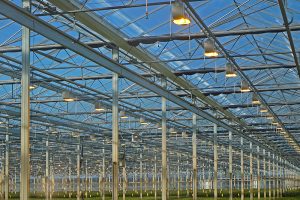 No. Treating HPS to LED replacement as a simple one for one fixture swap is one of the most common mistakes in lighting upgrades. A meaningful equivalence is not based on fixture count or nominal wattage; it is based on whether the new system delivers the required canopy PPFD, DLI, spatial uniformity, and thermal environment for the crop. Comparisons between HPS and LED are frequently confounded when the systems are not photon equivalent or when climate and canopy structure are not re optimised after the change.
An LED retrofit should therefore be treated as a system redesign, not a fixture swap. Layout, spacing, dimming strategy, light distribution, and HVAC / irrigation strategy all need to be revisited. This is especially important because LED systems commonly change the radiant heat balance experienced by the crop, which can alter transpiration, irrigation demand, and leaf energy balance even when air temperature targets are unchanged.
Why do some LED installations underperform?
LED installations usually underperform because of implementation errors, not because LED is inherently inferior technology. The most common causes are incorrect target PPFD or DLI, poor uniformity, insufficient adaptation of climate control, and failure to validate the lighting strategy on the specific cultivar being grown. Recent studies reinforce that distribution quality matters. More homogeneous illumination has been associated with improved crop consistency and better lower canopy performance.
Another common issue is overemphasis on spectrum while neglecting fundamentals such as light quantity, canopy structure, and environment. The evidence base in cannabis consistently points to DLI, PPFD, and distribution as the primary levers, with spectrum acting as a secondary optimisation layer. In retrofit projects, underperformance often reflects design and agronomy failures more than hardware failure.
Bottom line
The most robust evidence-based takeaways today are:
1. Optimise DLI, PPFD, and light distribution (uniformity) first
2. Treat spectrum tuning as secondary, strategic, and cultivar specific
3. Use subcanopy lighting where canopy density limits light penetration
4. Approach HPS to LED retrofits as full environmental redesigns, not simple fixture swaps
5. Validate every lighting strategy against your own genetics, canopy architecture, and facility conditions
It is also important to recognise that lighting is only one limiting factor. Changing the lighting strategy in a facility only delivers its full benefit when the other production variables are aligned alongside it, particularly ambient temperature, leaf temperature, humidity / VPD, irrigation, nutrition, CO₂ availability, and canopy management. In practice, plant performance is constrained by its most limiting factor, so increasing light without rebalancing the rest of the environment can reduce efficiency or create new bottlenecks rather than increase yield or quality. That is why lighting decisions should always be integrated into the wider cultivation system rather than treated in isolation.
Lighting in medicinal cannabis is not just an intensity question. It is a multivariable input that shapes morphology, physiology, yield, chemical uniformity, and secondary metabolite outcomes.
References
Ahrens, A. et al. 2024. A Study of Two High THC Cultivars Grown under 12 h vs. 13 h Days. Plants.
Collado, C.E. et al. 2025. Vegetative and reproductive stage lighting interactions on flower yield, water use efficiency, terpenes, and cannabinoids of Cannabis sativa. Scientific Reports.
Desaulniers Brousseau, V. et al. 2021. Cannabinoids and Terpenes: How Production of Photo Protectants Can Be Manipulated to Enhance Cannabis sativa L. Phytochemistry. Frontiers in Plant Science.
Garrido, J. et al. 2025. Subcanopy and Inter Canopy Supplemental Light Enhances Profitability of Medical Cannabis Cultivation. Plants.
Holweg, M.M.S.F. et al. 2024. The role of red and white light in optimizing growth and accumulation of plant specialized metabolites at two light intensities in medical cannabis. Frontiers in Plant Science.
Huebner, D.S. et al. 2024. Influence of different UV spectra and intensities on yield and cannabinoid profile of medical cannabis. Frontiers in Plant Science.
Kotiranta, S. et al. 2025. Decreasing R:FR ratio in a grow light spectrum increases yield but decreases total cannabinoid concentration in hemp inflorescences. Plant Science.
Peterswald, T.J. et al. 2025. The effects of far-red light on medicinal Cannabis. Scientific Reports.
Rodriguez Morrison, V. et al. 2021. Cannabis Inflorescence Yield and Cannabinoid Concentration Are Not Improved with Long Term Exposure to Short Wavelength Ultraviolet B Radiation. Frontiers in Plant Science.